Two photo puzzles were opened for the same gathering, and now their loose pieces share one pile. The question is no longer where a single missing piece went. It is which picture each piece belongs to. Before trying to finish either image, put both references side by side and make three destinations: puzzle A, puzzle B, and uncertain. Give a piece a home only when you can name the clue that separates the two pictures. This keeps a familiar color from becoming a guess you later forget.
The method below uses two example photos, a coastal scene and a family dinner table, to show the decisions. If you have only one set and one unexplained gap, use the missing photo puzzle piece checklist instead. Here, both sets are known to be present, but ownership of some pieces is unknown.
Keep the mixed pile stable and put both images in view
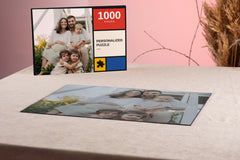
Photograph the mixed pieces and any partly assembled sections as they are now. The photo is a memory of the starting state if a group is moved twice; it does not prove how many pieces came from either set. Leave the two original boxes and their lids with their respective projects. If the boxes are available, place their printed image faces where you can see both at once. GiftMusea's current Personalized Photo Puzzle listing says the uploaded photo appears on its gift box, so that box can serve as an image reference. It does not establish a unique back, cut, or size for each order.
Write A on a separate note beside the first box and B beside the second. Label two shallow trays or clear table areas the same way, and reserve a third for uncertain pieces. Keep already assembled sections next to their matching reference rather than pulling them apart to create a perfectly uniform starting point. If a reference box is gone, use the original image for that order if you have it. With neither the box nor the original image, keep that side provisional; a remembered subject is a weak substitute for a visible reference.
Make a two-image map before moving ambiguous pieces
Look across both references for details that appear in only one. In our example, reference A shows a coastal lighthouse with red stripes, a dark stone path, a gull, and open sky. Reference B shows a family around a table with a checked cloth, a blue ceramic bowl, faces, and a pale wall. The two photos both contain pale blue: sky in A and part of the bowl or clothing in B. “Blue” is therefore a poor ownership rule. “Red stripe against white lighthouse” is much stronger.
| Reference A: coast | Reference B: family table | How the map helps |
|---|---|---|
| Red-and-white lighthouse beside open sky | Faces above a checked tablecloth | Distinct subjects can identify a piece before any assembly. |
| Dark path meeting pale shore | Blue bowl against the cloth | A boundary is useful when its two sides match only one image. |
| Pale blue sky | Pale blue bowl and sleeve | Color alone does not separate the sets; park an unmarked blue piece. |
Make a short map of distinctive areas in your actual pair. Ravensburger’s image-sorting advice supports studying clear sections and choosing a strategy suited to the image; it does not establish GiftMusea construction or a completion time.
Move clear pieces first; let the third tray do its job
Spread a small portion of the pile face up. Compare each candidate with both references, not just the one you hope it belongs to. In the example, a piece carrying part of the lighthouse stripe goes to A with high confidence because B has no lighthouse or matching red-and-white vertical form. A fragment of a person's eye above the checked cloth goes to B. Record the clue before continuing, especially if it would be hard to explain after the piece joins a larger group.
A piece showing a dark line beside blue might be A's coast, B's bowl rim, or something else. If neither reference gives a clear position, put it in uncertain. The pale-blue example stays there even if most A pieces are sky-colored. This tray is a deliberate holding place, not a failure. It protects both sets from a chain of false assignments. You can divide it into small visual subgroups if helpful, but keep the ownership label uncertain until new context appears.
Inspect backs, cut, and size only as observations
After a first image-based sort, you may notice a physical difference between the two actual sets. Lay one high-confidence A piece and one high-confidence B piece face down and compare them under the same light. Do their backs visibly differ? Does one group seem physically larger? Are there repeated cut features you can verify across several pieces already assigned by image? Record exactly what you observe, including when there is no usable difference.
Even a visible difference is a secondary clue. Check it against more than one known piece from each set before using it to move an ambiguous candidate. A smudge, reflection, or one unusually shaped piece can mislead. In the example, suppose both backs look alike: the worksheet says “no distinguishing back observed,” and the pale-blue piece remains uncertain. Suppose they look different: the piece becomes a candidate for one side, then still needs an image or neighbor check.
Build just enough context to test an uncertain piece
Build small separate sections around A’s lighthouse and B’s table before returning to the uncertain tray. You need neighboring image clues, not a completed puzzle.
Return to piece U4, the blue piece with a narrow white line. If a partly built A section now reaches a lighthouse edge against sky, compare U4's white mark and blue tone with the open position beside that edge. If the mark continues an observable lighthouse boundary and the gentle fit agrees, record the move to A as provisional. If the line cannot be connected to either reference with enough confidence, leave U4 uncertain. Keep the plain pale-blue U3 in the uncertain tray until neighboring detail identifies its owner. Do not turn a color resemblance into a confirmed match.
Check both sets for open regions while pieces remain uncertain. An open area does not yet establish a missing piece. The product listing confirms the photo-printed box, but no special sorting mark or guaranteed recovery result.
Copy this A/B/uncertain decision worksheet
Use one row per piece or small region whose ownership matters. “Reference A clue” and “Reference B clue” should say what each image shows at the proposed location, or “none identified.” Confidence describes the evidence, not your eagerness to clear the table. A row marked uncertain is a complete answer for now. When you move a piece, write the reason and what changed since the earlier decision.
| Piece or region ID | Reference A clue | Reference B clue | Confidence | Tray | Reason for move |
|---|---|---|---|---|---|
| L1: red-white stripe | Lighthouse stripe visible | No comparable stripe in family photo | High | A | Distinct printed landmark; moved from mixed pile. |
| F2: eye and checked cloth | No face or checked cloth | Face above the tablecloth | High | B | Two features agree with B; moved from mixed pile. |
| U3: plain pale blue | Could be open sky | Could be bowl or sleeve | Unresolved | Uncertain | Neither reference excludes the other; no move yet. |
| U4: blue with narrow white line | May meet lighthouse edge | May meet bowl rim | Provisional | Uncertain | Wait for a neighboring section to show which line continues. |
For each new row, name the visible mark, compare it against both references, and record a move only if a clue excludes the other set. If a test fails, return the piece to uncertain with an updated reason.
Questions that come up during a mixed-set sort
Can I sort by the backs of the pieces?
Only if the two actual sets show a repeatable difference you can see across pieces already identified by their printed image. In the example, identical-looking backs give no clue, so U3 stays uncertain. A single different-looking back is a prompt to inspect further, not automatic ownership.
What do I do with pieces that match both images?
Keep them in the uncertain tray and name the missing clue. “Pale blue” matches both photos; “blue beside the lighthouse's white edge” could become useful once that edge is assembled. A piece can remain unresolved at the end of one sorting session without making either puzzle wrong.
Should I count every piece before sorting?
A count may help you keep groups organized later, but it cannot assign a shared blue piece to A or B. Start with the two references and distinctive image clues. If you eventually find one defined gap in an otherwise reconciled set, consult the one-set gap checklist for the separate search question.
If you are choosing a future image, the custom puzzle photo guide explains what makes a picture readable across pieces. You can also browse the photo puzzle collection. For today's mixed pile, leave the A, B, and uncertain labels beside the work until every move has a visual reason.