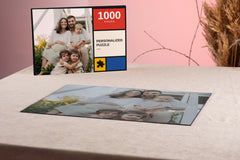
A family photo puzzle night can turn a familiar picture into an evening of stories. The activity begins before anyone opens the box: choose an image people are happy to share, decide where the pieces can stay, and give everyone a way to take part. The point is not to finish by a certain hour. It is to revisit a moment together while the picture gradually appears.
Choose a photo with a story people know
Start with a photograph that invites a story, not necessarily the most formal portrait you own. A backyard birthday can bring back the joke told before the candles were lit. A group picture from a holiday meal may remind everyone of the recipe, the weather, or the person who took the picture. Pick a scene with clear faces and a few visual landmarks so people can recognize parts of it as they assemble.
Think about who will be at the table. A surprise photo of a relative may be delightful, but a private or embarrassing moment can land badly when it is printed on a gift box and shared widely. Ask before using a picture when someone's comfort or privacy is uncertain. If one family member does not like being photographed, a shared place can work instead: a front porch, a favorite vacation cabin, or the picnic table where everyone gathered.
GiftMusea's photo puzzle comes with a sturdy box printed with your photo and, if you choose to add one, a short message. That box makes the image visible before the pieces are assembled. A message such as “The summer we built the porch” or “Sunday dinner, 2024” can cue the story without explaining every detail. Keep sensitive names or locations off the box if the gift may be opened in a larger group.
Choose a piece option for the gathering
GiftMusea offers 99 Pcs, 500 Pcs, and 1000 Pcs, plus a 100 Pcs XL option with larger pieces. A lower count can keep attention on a shared reveal; a higher count can become a project people return to. The XL option suits family nights with young children. No count guarantees a particular pace, and the photograph's repeated colors can change how the activity feels.
Picture your group and the evening. If relatives will drop in between dinner and dessert, a 99-piece choice might fit the loose flow. If several people like jigsaws and can leave a table undisturbed, 500 or 1000 pieces might give them more to work on together. A group can also begin a puzzle one night and return later. Choose for the way your family spends time, not for a standard label of easy or hard.
Set up a comfortable puzzle station
Clear a stable, flat work surface with good light. Make room for the box image, unsorted pieces, and sections in progress. Plan for the finished size: 13.5 × 19 in (34 × 48 cm) for 500 or 100 XL pieces and 27 × 19 in (68 × 48 cm) for 1000 pieces, plus room around it for loose pieces. If you plan to use a special board or a small table, check it against those sizes first. A few shallow dishes or trays can hold temporary groups of pieces, but keep them where they will not be mistaken for snack bowls.

Set the table so people can reach without leaning across each other's work. One person may want to sit and sort, another may prefer to stand and scan the picture. If conversation and snacks are part of the night, give food and drinks a separate space from the pieces. This is simple organization, not a special handling requirement for the puzzle. It reduces interruptions when people are trying to keep a cluster together.
Choose a stopping point before the evening begins if the table must be cleared. A tray or another dry, flat temporary surface can help keep groups together while you decide what to do next. If people will return another day, make sure the pieces and box remain together in a place where they will not be scattered. A comfortable plan matters more than a fixed schedule.
Share the work without assigning a race
Open the box and let everyone look at the image first. Some people like to find edges; others notice a bright sweater, a doorway, or the shape of a tree. Invite people to choose a region they recognize. In a reunion photo, one person might collect pieces showing the blue tablecloth while another works on the porch railing. They can trade groups when a section gets frustrating.
Leave room for different levels of participation. Someone may place many pieces, while someone else reads the box image, sorts colors, or recalls the story behind the photo. A relative who joins late can still help with one recognizable area. If the group stalls on a mostly uniform background, move to a section with clearer detail and return later. The goal is to keep the table welcoming, not to prove how quickly anyone can solve it. The same approach works with coworkers; our jigsaw puzzle team building activity guide adapts it for the office.
As the image forms, ask questions that invite memory rather than quiz people on exact dates. “Who took this picture?” can open a story about the person behind the camera. “What happened right after this?” shifts attention beyond the frozen moment. “Which detail did you forget was there?” encourages people to look closely. Give each person a turn to share, and let anyone pass. The photo may hold different meanings for different family members.
Use the box as a memory prompt
The printed box photo is useful when someone wants to place a piece, but it can also anchor conversation. Put it where everyone can see it, and point to a small detail you remember: a homemade banner, a dog under the table, or a familiar coat. One person can tell the story of the day, then invite another person to add what they remember. Memories will not always match perfectly, and that can make the conversation richer.
If you include an optional short box message, make it a title for the moment rather than a long speech. “Grandma's garden, every spring” can introduce a photo of a family gathering without taking over the image. The message belongs on the box, not the puzzle pieces. You can also leave the message out and let the picture prompt its own story.
Questions before family puzzle night
What picture works best?
Choose one that the group will enjoy seeing and that has recognizable faces, objects, or color regions. A picture with emotional meaning but an unclear subject may be less satisfying to assemble. Check that the people shown are comfortable with the image being shared and printed on the box.
How can several people work together?
Offer small tasks rather than fixed roles: collect edge pieces, sort a color, build one face, or compare pieces with the box image. Let people switch tasks or simply talk. This keeps the activity open to guests who join for only part of the evening.
What should we prepare first?
Pick a flat, well-lit surface, make space for loose pieces, and decide whether the project can remain there. Keep the box nearby for the photo reference. A 1000-piece puzzle finishes at 27 × 19 in (68 × 48 cm), so check that your surface fits it with space to spare.
Choose a family image you can share, then create a family photo puzzle with the piece option that fits your gathering. You can also explore personalized puzzles while you plan the night.