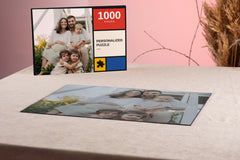
To run a team building puzzle, give small groups a jigsaw, set a clear time limit, and choose one rule: race, exchange missing pieces, or try a short silent round. Use your team's own photo if you want the activity to connect to a shared project. Finish with a brief discussion of how people divided the work.
A puzzle gives the group a visible task to work on together: sorting pieces, finding sections, and deciding where to focus next. You don't need to promise a productivity boost to make the session useful. Keep participation comfortable, make the rules clear, and leave time to discuss what happened.
Why use a jigsaw puzzle for team building?
A jigsaw is one of the few group activities where everyone can see progress at a glance. Nobody needs special skills or equipment, the rules take a minute to explain, and people can contribute in different ways: one person scans for edges, another sorts colors, a third works on a face or a logo. That makes it easier for quieter colleagues to take part than in a discussion-based exercise.
It also gives the debrief something concrete to talk about. Instead of abstract questions about collaboration, you can ask how the table decided who did what, when someone asked for help, and what changed after the first ten minutes. With a team photo or a project image on the box, the finished picture becomes a small reminder of the session rather than a generic activity.
1. Choose your team building puzzle format
Team race: use the same image and piece count
Give each table its own complete puzzle. For a fairer race, use the same image and piece count at every table, keep group sizes similar, and let everyone see the box image. Set a finish time as well as a finish condition. If no one completes the puzzle, stop on time and discuss each group's approach.
Split-puzzle swap: label the missing pieces
Before the session, remove a small set of pieces from each puzzle and place them in an envelope labeled with that puzzle's table number. Give the envelope to another table. Teams must ask for their matching envelope while working on their own puzzle. Keep kits separate and explain that trading envelopes is allowed; loose pieces shouldn't be mixed between puzzles.
Silent round: make it brief and optional
Ask willing participants to work without speaking for a short opening round, then return to normal conversation. Try three minutes within the regular activity block. Let people choose another role or skip the silent rule if it makes participation difficult. Afterwards, ask how they signaled a request or coordinated space on the table.
2. Pick a piece count and a time block
The table below is a planning guide for allocating activity time, not a prediction of puzzle completion. Image detail, familiarity with puzzles, and how much space people have can change the pace. Add briefing and discussion time around the working block.

| Piece count | Suggested group per puzzle | Planning activity block | Session approach |
|---|---|---|---|
| 99 pieces | 2–4 people | 15–25 minutes | A short race or swap round |
| 100-piece XL, larger pieces | 2–4 people | 15–25 minutes | A shorter session with larger pieces |
| 500 pieces | 3–5 people | 30–45 minutes | Work toward sections, with completion optional |
| 1000 pieces | 4–6 people | 45–60 minutes | A longer activity or shared ongoing project |
For a meeting with only half an hour available, start with the shorter formats. Save a 1000-piece puzzle for a longer block or a table that can remain set up afterwards. Our photo puzzle piece-count guide can help you compare options before ordering.
3. Choose a team photo people can recognize
Pick a well-lit group photo, approved campaign artwork, or a completed-project image. Check that the crop includes everyone you intend to feature, and offer another image if a colleague doesn't want their photo used. Remote teammates should be part of the choice too, even if they weren't present for the original photograph.
Varied colors and distinct areas give participants places to start looking. Avoid tiny names or a nearly blank background. GiftMusea uses one uploaded photo per puzzle; combine a collage into one image before upload. Our custom puzzle photo guide explains how to narrow down the image.
The Personalized Photo Puzzle has matte-finish pieces with a tight fit. Individual retail prices are $29.99 for 99 pieces, $29.99 for the 100-piece XL option, $44.99 for 500 pieces, and $64.99 for 1000 pieces. Its sturdy gift box carries the customer's photo and an optional short message. Try Built together — launch team, 2026.
4. Plan quantities and ordering time
Count tables before counting gifts: one activity puzzle can be shared by a group. If each employee will also take a puzzle home, list those separately. Don't order ten solely for a short activity when fewer kits would suit the group.
GiftMusea offers bulk pricing from 10 puzzles, with a custom quote for 100 or more. Each puzzle can have a different photo, and your logo can go on the gift box with a short message. For a race, request matching images and piece counts. A design proof is sent before production, which starts after approval.
Bulk production takes 2 business days to 4 weeks depending on quantity and custom requests. US and EU delivery is about 4 days after dispatch. Allow time for photo selection and proof corrections before production; these estimates do not guarantee arrival for your event.
5. Set up and run the session
- Prepare each table. Leave room for the puzzle and sorted pieces, display the box image, and label each kit. Check seating and reach before assigning groups.
- Explain the rules. State the time limit, whether reference images are allowed, and how swaps work. Make completion optional for longer puzzles.
- Offer starting roles. People can look for edges, sort colors, assemble a section, or handle envelope requests. Let them change roles instead of keeping one person in charge throughout.
- Start the timer. Announce halfway and a few minutes remaining. For a silent round, clearly signal when normal conversation resumes.
- Close the activity. Stop at the stated time, acknowledge unfinished sections, and keep pieces with their original kit. Leave several minutes for discussion.
For a 30-minute session, you could allow five minutes for instructions, twenty for puzzle work, and five for discussion. That is an agenda choice, not an expected completion time. The photo puzzle night ideas offer more ways to organize a shared table.
6. Debrief with specific questions
- How did you decide who would do what?
- What helped someone join a section already in progress?
- How did you ask for a piece or an envelope?
- What would you change if you had another ten minutes?
Keep the discussion about choices people made during the activity. Avoid using a race result to rank employees' ability or drawing conclusions about someone who preferred a quieter role.
Running a puzzle activity with a remote or hybrid team
A physical jigsaw still works when part of the team is remote; the setup just needs more planning. The simplest option is to send each remote participant a small puzzle with the same image, such as 99 pieces, and run a timed round on the video call. Everyone builds at the same time, and the debrief happens together on screen.
For a hybrid meeting, give the remote colleagues a defined role instead of making them watch. Point a camera at the shared table, share the reference image on screen, and let remote teammates guide one section: they call out which colors or shapes to look for, while someone in the room places the pieces. Agree beforehand on a simple grid, such as rows A to D and columns 1 to 4, so directions are clear. If you plan to ship puzzles to several homes, collect addresses early and check the delivery time for each country.
A 15-minute puzzle icebreaker for meetings
When you only have a quarter of an hour, use a 99-piece puzzle per group of three or four. Spend two minutes on the rules, ten on building, and three on a single debrief question, such as “What did you do when you got stuck?” Completion is not the goal; the point is to get people talking and working side by side before the main agenda.
A recognizable image makes the icebreaker more personal: last year's team outing, the office building, or a product launch photo. For seasonal events, the same idea works as a shared gift; see our Christmas gifts for coworkers for team-photo ideas and per-person prices. If you meet clients at events, our guide to trade show giveaways shows how a small photo puzzle can work at a booth.
More team building games with puzzles
Once the basic race works, these variations keep the activity fresh for indoor team building at the office, an offsite or a holiday party.
- Puzzle relay. Each team sends one person at a time to the table for 60 seconds, then the next teammate takes over. Teammates can coach from behind a line, which keeps everyone involved.
- Mystery picture. Hide the box image. Teams build without a reference and, at set checkpoints, guess what the photo shows. Works well with an office or team-outing photo.
- Team mosaic. Give each group a 99-piece puzzle with a different photo, such as one per department. When they finish, put the puzzles side by side on a table or board to show the whole company.
- Puzzle scavenger hunt. Hide labeled envelopes of pieces around the office with a clue in each. Teams solve the clues to collect the pieces they need to finish.
- Break-room puzzle week. Leave a 1,000-piece puzzle of a team photo in a shared space for a week. Anyone can add pieces during a break; finish it together on Friday.
For each game, keep the same principles: clear rules, an optional finish and a short debrief. Bulk orders can mix matching and different photos, so one order can cover a race and a mosaic.
Common mistakes to avoid
Don't give one table a simple image and another a dense collage, then call their race equivalent. Avoid overcrowding the table, leaving swap envelopes unlabeled, or extending the session because a puzzle is unfinished. A clear stopping point respects the rest of the meeting.
Your session checklist
- Format, piece count, and group sizes chosen.
- Photo permissions, crop, and box message checked.
- Order quantity and intended event timing discussed.
- Bulk design proof approved before production.
- Tables, reference images, kit labels, and timer ready.
- Swap envelopes prepared, if needed.
- Participation choices and debrief questions agreed.
FAQ
Does every group need to finish the puzzle?
No. Set a working block that fits your agenda and let completion be optional, especially for 500- or 1000-piece puzzles. The timing table is a planning guide rather than a finish-time promise. Stop when scheduled and discuss how the group divided tasks, asked for help, and adjusted its approach.
How do we keep a puzzle race fair?
Use the same image and piece count for every table, keep group sizes similar, and give everyone the same access to the box image. Explain the start and stop rules before beginning. Check that every kit has its pieces, and don't compare race results as a measure of employee performance.
Can we use different photos in a bulk order?
Yes. Each puzzle can have a different photo, and bulk puzzle boxes can include your logo and a short message. Different images suit separate keepsakes, but matching images make more sense for a comparable race. Review the design proof before approval, and include quantities and destinations in your quote request.
Browse the corporate gifts collection for your event, or request a quote for bulk custom puzzles with your table count, photo plan, and intended session date.